Anderson Electric Car Company & Detroit Electric
Car Company
For information about Detroit Electric models please see the C-D webpage.
Detroit Electric branded cars were made in Detroit, Michigan, from 1907 to 1939. Detroit Electric trucks were made from 1911 to 1916.
William C. Anderson was the founder, a principal owner, and Company President through the 1920s.
From 1907 to 1911, they were made by the Anderson Carriage Company.
From 1911 to 1919, the name was the Anderson Electric Car Company.
In May of 1919, the name became the Detroit Electric Car Co when electric car manufacturing separated from both the auto body building business and Elwell-Parker. For several months the “Anderson Electric Car Co” name (with Towson as president) was used by the remaining coach building company, until threatened with a lawsuit.
After 1929, William C. Anderson and the original management were no longer involved. About a hundred more cars were made (re-manufactured) by the new Detroit Electric Car Company (1930-1932), and then, the Detroit Electric Vehicle Manufacturing Company (1934-1939).
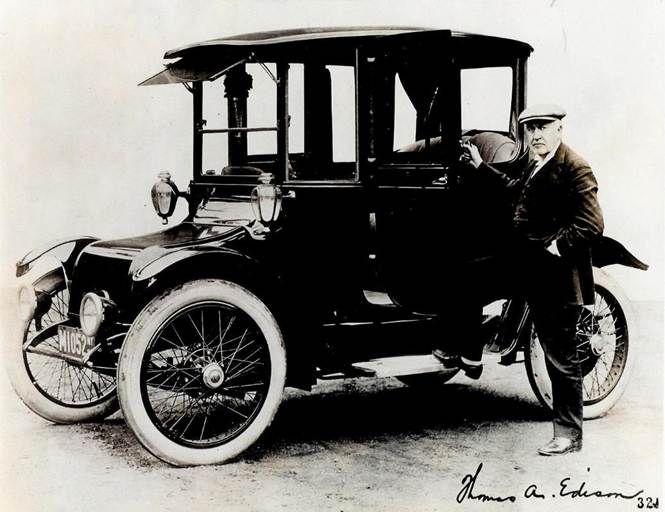
Edison with his 1914 Detroit Electric Model 47, a
Christmas Gift from Henry Ford.
Detroit Electric was the best-selling and longest-lasting maker of these vehicles in the twentieth century. They made around 12,900 pleasure cars, closely followed by Baker, Rauch & Lang, Waverley, Ohio, Columbia, and Milburn – which had strong sales in the late teens, but started too late to catch up. Ohio, with four of the seven biggest brands, led all states in electric car production.
William C. Anderson was born on November 9th of 1853 to Hiram Anderson and Susanna Cummings in Milton, Ontario, Canada. The family moved south to Port Huron, Michigan. Hiram and William established a farm equipment firm called Anderson & Company In 1874, becoming regional wholesalers for Studebaker and other brands. William married Ida F. Beard in 1877, a daughter of James Beard, one of Port Huron’s leading citizens. By 1880 he was doing well enough to buy his first house. William and Ida had two daughters.
Port Huron was an ideal location along the St. Clair River. All shipping between Lake Huron and Lake Erie had to pass by the town, which had port and shipbuilding facilities. This location was less vulnerable to the storms that assailed ports situated directly on the great lakes. Telephone service was introduced in 1881. In 1891 the Grand Trunk Railway, which had been ferrying rail cars across the river since 1858, built the first underwater railroad tunnel in America, creating an all-weather rail link between Canada and the United States. In 1886 Port Huron became the third American city to get a commercial electric streetcar line.
By 1884 Hiram had retired and William formed a partnership with his brother-in-law called Anderson & Co. They moved the business into a larger two-story brick-front building at 210 Huron Avenue, across the street from the town’s best hotel, and flanked by two others.
Anderson had manufacturing aspirations, so he sold his share in Anderson & Co to establish the Anderson Cart & Carriage Co around 1890, making Rockaway and Daisy style two-wheel carts along with carriage tops and other accessories. William P. McFarlane, a carriage trimmer from Detroit, became the factory manager, while Anderson handled finance and sales.
A trade publication from June 1st, 1893 reported them as having $12,000 in invested capital and annual income of $100,000; employing 30 men and 10 women. A day’s wages ranged from $1.50 to $1.75. He closed the business later that year as the recession of 1893 set in. He probably went to the Columbian Exposition in Chicago.
Anderson then moved south to Detroit for its large immigrant labor pool and more affluent urban client base. He took McFarlane with him.
The Anderson Manufacturing Company built a two-story timber-frame factory in 1895. The new factory sat on a bit less than one acre. It was only slightly larger than the building back in Port Huron, but no space was taken up with retail sales. They commenced manufacturing light carriages and buggies.
The area was called “Milwaukee Junction” for the intersection of the Detroit & Milwaukee Railroad with the Grand Trunk Railroad. Anderson knew the Grand Trunk well, as it swept down from Canada, helping change Port Huron into a shipping and immigration hub. Some thirty years earlier, the Grand Trunk Railroad had swept away the town’s boy genius, Thomas Alva Edison.
Anderson obtained fresh funding from North Michigan lumber baron William M. Locke. He found equity and influence in Detroit from department store magnate Cyrenius A. Newcomb, who in partnership with William Pungs, developed the tract where Anderson’s new factory was located.
Anderson Manufacturing had a brief merger with Pungs’ adjacent Michigan Railway Supply Company, whose factory was three stories tall and filled all of the neighboring parcel. They had a 55% larger factory with unused floor space, allowing Anderson’s buggy builders to increase production. The merger was a mistake, and Pungs was forced out on June 1st, 1899. Both factories became Anderson Carriage plants, and Pungs’ brake beam manufacturing moved to Chicago.
On May 29th, 1899, the company name was changed to the Anderson Carriage Company, under Anderson, Locke, and Newcomb. A new three-story brick structure, very similar to the adjacent “brake beam” building, replaced the original two-story, timber-framed, Anderson Manufacturing building.
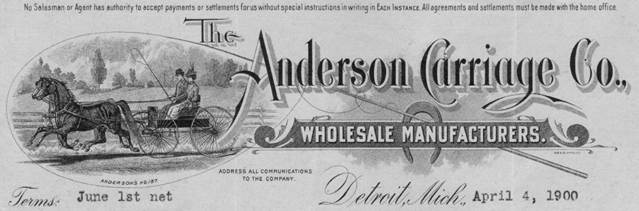
Anderson Carriage Company letterhead
It is widely stated that in 1900 a third of the automobiles in the United States were electric. This is only true if the “electric cars” included the one or two thousand lead cabs that briefly flourished in the major cities, but were a failed concept by 1902, and nearly gone by 1907. During that same period, explosion cars became cheaper and more manageable.
Factory Manager William P. McFarlane was elected secretary of Anderson Carriage. He is credited with designing the production techniques that allowed competitive manufacturing with very high quality control and was one of the few employees who got equity in the company.
William C. Anderson was becoming prosperous. In 1902, George DeWitt Mason designed a fine two-story brick house for him at 65 Rowena, a wood-block paved street a couple miles from the factory that was later widened and renamed Mack Avenue. In good weather, Anderson liked to ride to his office on one of his prized Kentucky thoroughbreds, with a dog trotting alongside.
By the end of 1903, Anderson Carriage had become one of the larger manufacturing companies in Michigan. The main factory occupied buildings 90 feet wide, three stories tall, and a combined 600 feet long. They had the luxury of two rail sidings, one for receiving raw materials, and one for shipping new vehicles.
Across a rail spur and siding, west of the factory, between Clay and Aberle, Anderson built a two-story timber building for general offices, vehicle storage, final inspection, dynamometer testing, and shipping. This gave the company its first legitimate street address, as the original factory buildings were between two rail sidings with no street frontage.
Anderson Carriage offered 100 styles, including the well-known “High School” line of light horse-drawn vehicles; eventually selling as many as 15,000 units a year. They claimed to be the largest user of rubber tires in the country.
Both the factory and Anderson’s social circle were at the center of the rapidly developing Detroit motorcar industry, and he was interested in participating. Anderson was an acquaintance of both Thomas Alva Edison and Henry Ford. While Ford worked at Detroit Edison he had a brief encounter with his hero at the 1896 meeting of the Association of Edison Illuminating Companies which took place in the Oriental Hotel at Coney Island, New York. Edison encouraged Ford to continue pursuing explosion cars, as batteries of that time were very limited in capacity and reliability. Anderson was the one who reintroduced the two men, after Ford had become a successful automobile manufacturer. By then Edison had swung to promoting electric cars using his new alkaline battery.
The Anderson Carriage Company’s neighbor at Milwaukee Junction was the C. R. Wilson Body Company, an established coach-builder that became an early adopter by supplying motorcar bodies for Ford, Cadillac, and others. Fred Fisher made the 1905 Osceola Coupé prototype for Henry Leland and the 1906 Model H Coupé bodies for Cadillac at Wilson. It was thought to be the first production model inside-drive gasoline car. Inside-drive electrics had been around since ~1898 (i.e. Woods and Sperry/Cleveland). Having the driver inside the cabin was a fairly new concept as it is not practical to control horses from inside an enclosed vehicle. Most early Coupés kept the driver out in the weather, as if to control electric horses.
In 1905, American manufacturers made around 1,200 electric cars, which was about 5.5% of total automobile production.
William C. Anderson had been approached by a number of men who wanted him to fund automobile projects, including the notorious Edward J. Pennington with his hot air engine. George M. Bacon arrived at Anderson’s office in October of 1906. Bacon explained how he had designed successful electric cars for the Firestone family’s buggy works, under the Columbus brand. Anderson’s Cleveland carriage competitor, Rauch & Lang, had begun electric car production a year earlier, and electric cars seemed a plausible niche in the emerging industry. Anderson gave Bacon the use of factory facilities and purchased the necessary materials. Four-months later, Bacon completed a vehicle with the same robust Elwell-Parker motor and control system used in Baker and Columbus Electrics. He reportedly pulled this prototype in front of the Anderson Carriage Co office building for a demonstration. "If you don't think it will run just watch me start," said Mr. Bacon. Then, he touched a lever, and, without explosions or jerks, the car started on its way and kept going. Mr. Anderson took the driver's seat and found to his delight that he could easily control the car. Anderson was so overcome with enthusiasm and excitement that when it came time to stop he kept yelling "whoa, whoa!" But he forgot to pull the control lever back to the neutral position. Although this first experience was more memorable than necessary, any doubts about the car were removed by the demonstration. Anderson hired Bacon to design and build automobiles.
The Anderson Carriage Company chose “Detroit Electric” for their brand, as most competition came from Cleveland. During the summer of 1907, Bacon did a series of thorough tests with the prototype Model A Victoria. Using standard equipment he achieved 140 miles on a single charge, with two passengers, over ordinary streets, at an average speed of 12½ miles per hour.
On September 9, 1907, the brick and wood factory on the adjacent parcel, which was built for Pungs and awarded to Anderson Carriage in a lawsuit, burned to the ground. This put a crimp on early production, but several cars were near completion, and Anderson shipped their first electric car a few weeks later. By the end of 1907, ten cars had been shipped.
A replacement factory building was soon under construction, designed and equipped with the electric vehicle project in mind. Using new concrete construction methods developed by Albert Kahn’s younger brother Julius, architect George D. Mason’s company designed a new three-story reinforced concrete building 303’ 4” long and 90’ 4” wide. It was ready for occupancy that December.
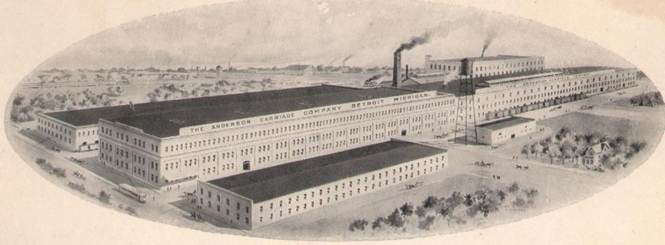
Circa 1908, Anderson’s factories were purely functional
and not much to look at. The artist has
omitted a row of houses along Clay, to the left of the main building, and most
of the C. R. Wilson factory.
The first series of automobiles were similar to the cars Bacon designed for Columbus. Models A, B, C, and D were on the same chassis, designed so that bodies could be switched to suit the occasion. Early styles included the Model A Victoria (B, same as A with top), Model C Coupé, Model D Brougham, and Model L a cape-top Roadster. The Coupé and Brougham were fully enclosed with plywood roofs. The Brougham had curved-glass front-corner windows, which would become emblematic of the brand. They were twin-chain drive from one motor through a differential and jack-shafts. The Model L was an exception. It used silent-chain drive to the rear axle, and had a faux radiator – the first attempt at a sporty Detroit Electric.
Henry Ford, who was starting production of his famous Model T a few miles away on Piquette Avenue, bought a 1908 Model C Coupé for his wife Clara, “shipped” July 16th, 1908. It was her first of four electrics. Clara’s operating expenses, as of December 1st, 1909, were $14.20 for general repairs, $109.65 for tires, and 90¢ in battery maintenance. The car had clocked 4,800 miles.
In 1908, the Anderson carriage factory was twice the size of Ford’s.
In a letter to Ford, Anderson claimed that 100 owners had accumulated nearly 400,000 miles at an average cost of 1½ cents per mile. Electrics, except for battery replacement, had the lowest cost of operation.
For the first few years, the chassis and some other metal parts were purchased from outside vendors. In the calendar year of 1908 only 184 cars were shipped, and in 1909 just under 600. By 1910 it was clear that electric cars had great potential, and Anderson constructed a new factory to manufacture chassis and axle components. When it was finished, Anderson was able to make almost every part of the car in his own plants, giving full quality control over every manufacturing process.
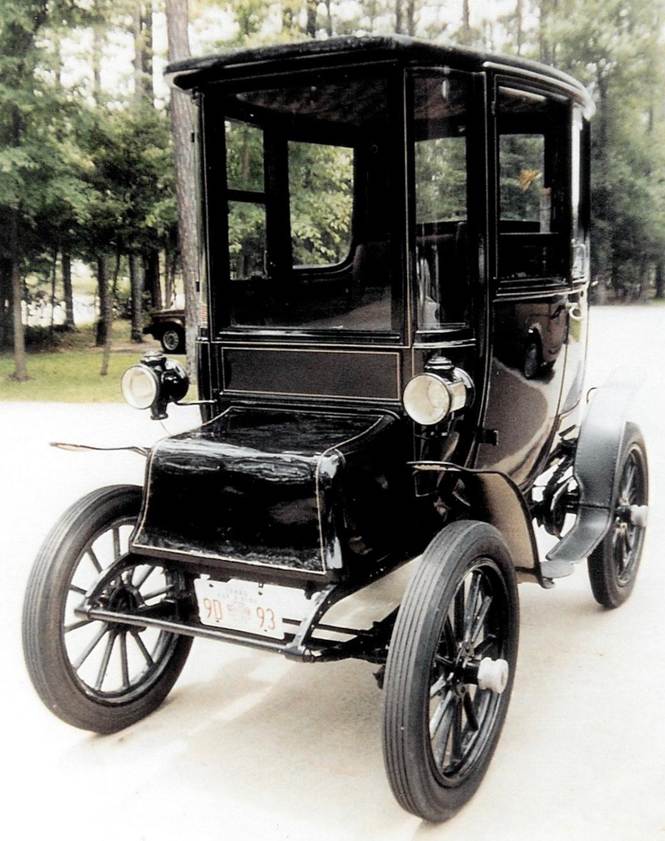
1909 Model D Brougham
George Bacon’s experience at Columbus taught him that it did not matter how good a car one built if the battery was not properly made and maintained. Some of the most nettlesome battery problems were not electrical but physical. Pure lead is heavy and mechanically weak, compared with most metals. Applications at that time, such as telegraph and telephone exchanges, used a stationary battery for backup power. These were built on-site in large lead-lined wood cases. The lead plates only had to support their own weight. Automobiles, particularly on the bumpy, rutted streets of the time were subjected to shock and stress from all angles. Other metals, whose alloys with lead didn’t compromise the electro-chemical qualities of the plates, had to be found that gave the lead more stiffness and tensile strength. Physical designs were developed to keep the lead paste, critical to high-capacity cells, from shedding off the plates. The battery sets needed to be held firmly in place to keep from breaking the cell jars or loosening the electrical connections. Cell jars were originally made of glass, by this time they were made with Vulcan hard rubber, which was more expensive, but less likely to shatter.
Bacon hired a bright industrious young man named Elwood T. Stretch, with no background in electricity or chemistry, to make in-house battery sets for the cars. Stretch was sent to the Willard Battery Company in Cleveland to learn the art. The first Detroit battery built by Stretch was installed January, 1909, in a Model L Roadster that was painted canary yellow. E. T. Stretch remained with Detroit Electric through the early 1930’s, the longest association with the company of anyone other than Anderson himself.
Anderson Carriage Company’s big seller around this time was a light, single-seat one-horse buggy that cost $25. The cheapest electric car they made was the Model L Roadster at $1,400. A Model T Ford sold for $850. An average worker’s yearly wage was less than $400.
A New York Times article hinted that General Motors was interested in getting into the electric car business and looking into acquiring Elwell-Parker, the motor supplier to Babcock, Baker, Columbus, and Detroit Electric.
Alexander Brown invented machinery for unloading coal from the Great Lakes steam ships, of which his father happened to have a fleet. He decided the most suitable motor and control system to run his invention was the one made in England by Elwell-Parker, recently acquired by the Electric Construction Company Ltd. The Brown family bought the US rights for the Parker designs in 1893, and established Elwell-Parker of America in Cleveland.
At the urging of his son-in-law, Frank Price, Anderson bought the 92½% ownership in the Elwell-Parker Electric Company owned by the Brown family, securing exclusive use of their superior motor and control system for automobiles. E-P General Manager Morris S. Towson bought the remaining 7½% from the British interests. The team that traveled to Cleveland for negotiations were Anderson, Price, and in-house attorney Wilson Critzer. Elwell-Parker was given a capital value of $400,000, increasing the capitalization of the Anderson Carriage Company from $500,000 to $900,000. Elwell-Parker remained in Cleveland supplying Detroit Electric with motors and controllers, while continuing to grow their business making material-handling vehicles and equipment.
Beginning in 1908, Detroit Electric set up a series of highly publicized road tests to acquaint the public with the sturdy dependable qualities of their car, and its capacity for speed and distance. George Bacon and Gordon Fairgrieve drove a Model A Victoria from Detroit to Atlantic City, taking turns between driving and photography. They departed from the Hotel Pontchartrain at 1:00 PM, July 12th, with great fanfare. Hotel Pontchartrain’s bar was the hangout for automotive pioneers before the re-formed Detroit Athletic Club opened in 1915. The 1,060-mile trip was made over muddy, rutted roads without a breakdown. Several scheduled stops were made to demonstrate the car to potential dealers. When charging facilities were not available, Bacon would occasionally throw wires over power or trolley lines. After returning to Detroit and before any maintenance service, the car was given a test run to see how the battery (that Stretch built using Philadelphia Diamond-Grid plates) was holding up. It went 113 miles on a charge. This feat was reported by many publications and featured in the 1909 sales brochure, along with print ad campaigns and a special booklet about the trip.
The various electric car companies often used Victoria models for these tests because they had light bodies. Around 12 mph was typical, as this was achieved at the most efficient speed position. This was faster than a horse drawn carriage or streetcar, and aerodynamics was not a consideration.
On September 22-29 1909, Detroit Electric completed the round-trip Boston-to-Washington Munsey Reliability Tour. George Bacon averaged more than 100 miles per day over the course, with a total mileage of 1,282.1. They were not one of the 37 competitive entries but were allowed to make the run with an official observer. He certified that the trip was made with no mechanical failures, just some tire trouble, which was to be expected back then.
To provide customer support infrastructure, Anderson built three Detroit city charging garages and made agreements with two private ones. Part of the success of Detroit Electric was careful supervision of battery maintenance. With early electric cars, only pneumatic tires were more likely to cause trouble. Every morning, employees would deliver clean, fully charged cars to many clients’ houses, and bring them back to the garage in the late evening. Some had a chauffeur stay with the car all day. For employees, electric streetcars served all locations, the factory campus and charging garages. An early Model A Victoria, probably the one used for the road tests, ran auto parts between the factory and garages, and took drivers to the customers’ cars. In 1910 the monthly charge was $30 for cars stored and delivered, $24 for cars stored and picked up, or $10 for battery maintenance only. File cards recording time in and out, along with all charging data, were meticulously kept. About half the electrics in Detroit were recharged in public garages. By 1915 independent charging garages had become numerous, and Anderson got out of the business.
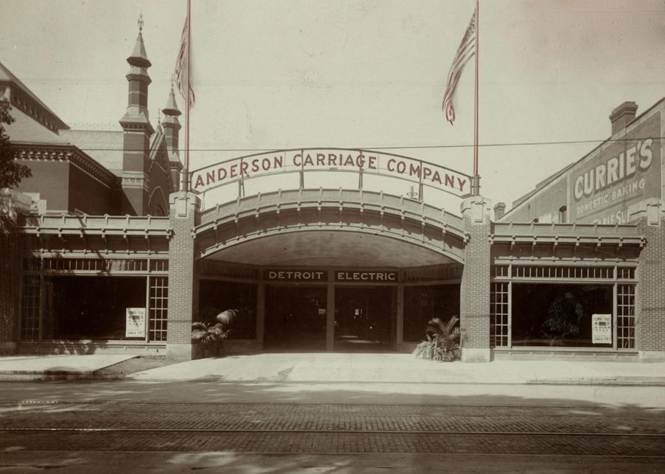
Station A, c.1909, before the second floor was added.
Station A was also the Detroit factory showroom, opened December 1st, 1908 in a brick building measuring 85 by 185 feet. A second floor was added in 1910. It was located near downtown at 687-91 (now 6040) Woodward Avenue, between Woodward Terrace and Martin. There were glass front showrooms on either side of the street entrance, with offices and storerooms just behind, followed by two rows of cars, with a wide passage between them. At the rear was a 14×9 foot electric elevator for taking cars upstairs. The garage had a 90-car capacity, with up to 60 charging at a time. All wiring was in conduit under the cement floor, with a master switchboard controlling each station. A battery assembly and conditioning room was upstairs, along with repair and storage facilities. Although maintenance of the running gear was minimal, lead-acid batteries required frequent and informed attention. Whether the cars were garaged privately or commercially, they were regularly inspected. Anderson’s staff would even visit a customer’s residence. A written report for each car was held on file at the office.
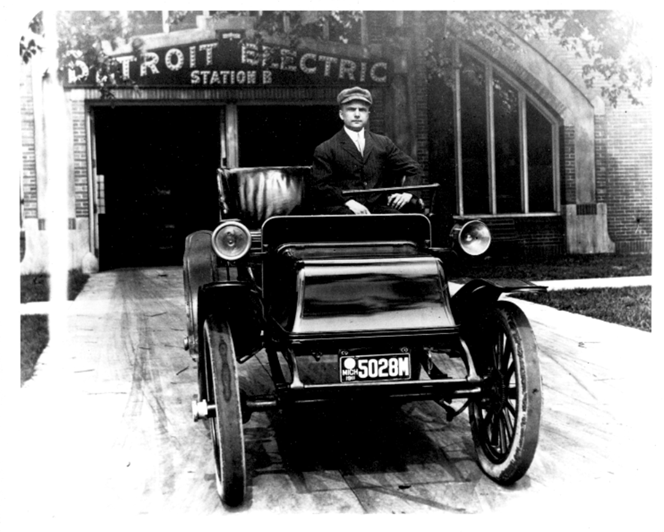
Detroit Electric Station B with a Detroit Victoria.
Detroit Electric Station B was their East Side Garage, located at 112-114 East Grand Boulevard, a block from the Belle Isle Bridge. Each spring, cars were garlanded with flowers for a parade on Belle Isle, many of these were Detroit Victorias, garaged at this convenient location. The station was 120 feet deep, 60 feet wide, and 25 feet high at the center, with a 60-car capacity. The façade had a triangular peak at the center, but the roof behind it was a freestanding barrel vault. There were no columns to be hit by cars. Luna Park, said to be like Coney Island, was along Jefferson Avenue a short walk away.
George Mason designed the Chicago showroom. It was established in late 1909, and financed by landlord Bryan Lathrop, based on a 15-year lease. Chicago was emerging as a center for electric car ownership and the Detroit Electric was well received. Factory branches were also established in other metropolitan centers, such as New York, Kansas City, Cleveland, and Buffalo (which had the lowest electricity rates in the nation).
Anderson favored buying a quantity of simple black-and-white ads in a variety of publications appealing to the affluent. These look like they were produced in-house, and usually feature line-drawing illustrations with a lot of text. Dealers were expected to buy space in local publications, such as newspapers and opera programs. In 1909, Anderson did buy an expensive full-page color ad in Life magazine. Anderson’s principal competitors, especially Rauch & Lang, Baker, and Milburn spent a lot of money during the teens on some of the more extravagant color ads found in prestige magazines of the day.
All electric car makers combined produced 3,835 North American electric pleasure cars in 1909, about 4.6% of total automobile production.
Edison developed animosity toward acid batteries from a bad experience in his youth. He spent much of his personal fortune and reputation developing an alkaline Nickle-Iron cell. The first version, introduced in 1903, was a disaster. The cells lost storage capacity and the seams leaked. After much expensive development the Edison Battery was finally reintroduced in 1910 to great fanfare. Some thought it would allow the electric to eclipse gasoline cars, and it inspired several more companies to go into the electric car business. The main issue Edison couldn’t solve was price.
William C. Anderson knew the Edison family from his Port Huron days. His father-in-law, James Beard, was vice-president of the Port Huron Street Railway Co when Thomas Edison’s older brother, “Pitt” Edison, was the superintendent. Anderson made a deal to be the “exclusive” provider of the Edison Battery in automobiles. Exceptions were made for low-volume producers Bailey & Healey.
The increased range from the Edison battery set off a spate of new road tests. Baker especially competed with Detroit Electric for single-charge mileage records using the new Edison Alkaline Battery.
On August 30th, 1910, Emil Gruenfeldt ran a Baker for 201.6 miles on a single charge with an Edison A6 battery.
In September of 1910, the factory Bailey Victoria ran a test with the new Edison Battery from New York to Boston and back, around 1,000 miles. There was a side trip to the peak of Mt. Washington, New Hampshire (6,148 feet). Although not mentioned in Bailey literature (nor visa-versa), a Detroit Victoria, ran the same trip, often alongside the Bailey, with equal success.
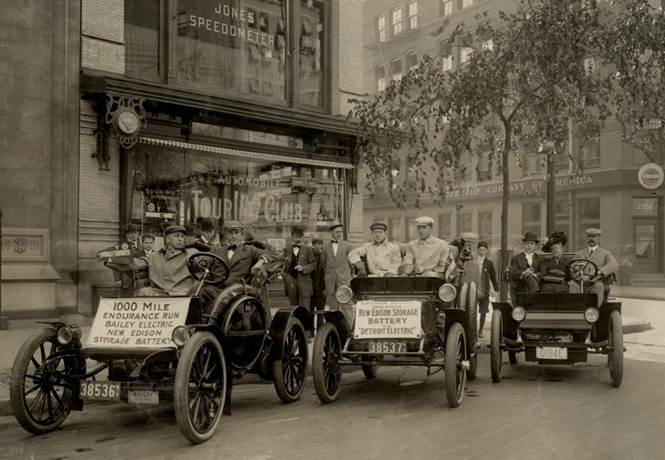
1910: Bailey and Detroit Electric chain-drive Victorias test the Edison Battery.
On October 5th, George Bacon drove a chain-drive Detroit Victoria for 211.3 miles.
On November 9th, Gruenfeldt drove a shaft-drive Baker Victoria 244.5 miles. The run was made over 19 hours 20 minutes at an average of 12.65 mph in rainy weather. There is a photo of him demonstrating this car to Edison.
The outcome of these various tests showed the greater capacity of the Edison Battery (50% by weight), and slightly better efficiency of Baker’s shaft-drive. Detroit Electric introduced shaft-drive cars the following year and delivered a shaft-drive Model 15 Detroit Electric Victoria to Edison, which he never sold.
It is a widely held impression that early motorcars were painted black. This misconception is probably from two factors – in black and white photography dark colors appear black, and Henry Ford’s “Any color as long as it’s black” – a popular antique car quote. Typical paint colors for most brands of electric cars, including Detroit Electric, included a black chassis (which usually included the fenders and often the hoods), but the body panels were listed in the brochures as blue, maroon, or green. These were bespoke cars and would be painted any color to customer demand. Ford liked black because it dried faster, saving him acres of indoor space while waiting for paint to dry. Before the 1920s black paint sped up production, it was also cheaper and more durable. This was much less of a problem when producing fewer than a dozen vehicles a day. With Detroit Electric models, the maroon and the blue were nice and deep. The green was the unfortunate dark grayish one introduced by the Brewster Carriage Company for J. P. Morgan, thought to convey an elite status. Roadsters were more likely to be painted in flashy colors to attract attention. During the mid-teens some otherwise stuffy-looking Broughams were painted in bright colors. As the realities of the war in Europe came to dominate, overt exhibition of privilege began to appear gauche.
In November of 1910, Anderson Carriage completed a new metal fabrication factory, with 72,000 square feet of floor space, for production of chassis and driveline components. It sat on land across Aberle from the offices, where stables, a carriage house, and a water tower had been.
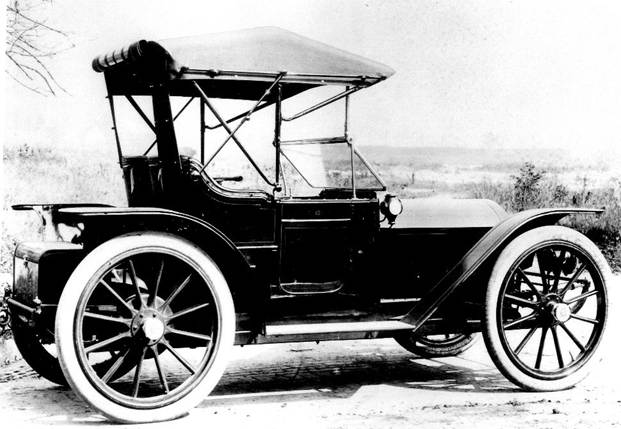
1911 Model 17 Underslung Roadster
1911 was a transformational year for Detroit Electric. In January the company was re-incorporated as the Anderson Electric Car Company to reflect the shift from being a regional buggy builder to becoming a major luxury electric carmaker. The board of directors had nine members –– William C. Anderson, president & general manager, William M. Locke, treasurer, with Cyrenius A. Newcomb, George M. Bacon, Gordon D. Fairgrieve, William P. McFarlane, Frank E. Price, and Wilson Critzer. By March, financier Dr. J. B. Book Jr. had joined the board.
Now that they had their own chassis and driveline factory, with state-of-the-art machine tools, they introduced a wide array of new models that must have been confusing to potential clients. The original twin-chain drive was supplemented by two new drive systems, including their first shaft-drive, and a chain-drive using tandem silent chains. They dropped the alphabetic designations and began to use numbers for the different models, starting with m10, an Extension Brougham.
Most companies used a high-speed (1,600-1,800 rpm) motor. Although these were smaller and lighter for the same power, they required a secondary speed reduction (by gearing or chain) when coupled with a straight-bevel-gear shaft drive system. The Elwell-Parker motor design in Detroit Electrics had lower speed (800 rpm) allowing direct shaft-drive with straight cut bevel gears. The greater heat sink of the more massive components also gave better short-term overload capacity. Anderson engineers realized that the most efficient and robust motor/control system could beat cars by platform innovators such as Baker, and fancy coachbuilders such as Rauch & Lang.
1911 body styles were available with any of the three different driveline options, creating 13 models, plus the company’s new line of trucks. The trucks were all twin-chain drive, with wheel steering and an under-slung battery. They were available with load capacities from 750-10,000 pounds.
Advertising for 1911 announced the option of ordering cars with the A6 Edison Battery having a capacity of 225 Ah. A proprietary lead-acid battery was 168 Ah. The 40-cell Edison Battery provided additional range at a substantial additional cost of $600.
Anderson stopped producing cars holding fewer than 24 lead-acid cells (48 Volts) for most models. Some bodies were still available separately for those who wished to change the body to suit the season. The Model 17 Detroit Electric Roadster of 1911 featured a tandem silent chain drive system very similar to a driveline patent Morris S. Towson filed for on April 1, 1909. This model featured the only under-slung chassis Anderson ever made and was their sportiest looking car. Towson had built Elwell-Parker from being the motor maker for Brown’s ship unloading machinery into a more diverse maker of equipment using their motors and controls, including tows and lifts. Towson remained the general manager of E-P after the Anderson buyout. Although listed as president of the Anderson Electric Car Co in 1919, this was after the electric vehicles part had become “The Detroit Electric Car Co.”
The Elwell-Parker system split the battery into two halves. This allowed the battery to supply half of the full voltage for lower speeds. When combined with wiring the field coils in two pairs, simple switching provided four speeds with no wasteful resistance added. The first speed position did have a heat dissipating resistor in series, for a smoother start and so the car could be held against the brake while parking, giving a total of five speeds. Most manufacturers used the “continuous torque” system, which kept the battery in series and was a bit smoother in speed transition. With greater use of resistors it was a little less efficient. The continuous torque system typically had six speeds.
On October 14th, 1911, Edison wrote to Anderson confirming exclusive use of his battery for pleasure cars in 1912. The letter guaranteed the battery would keep its rated capacity for four years and suggested that Anderson warrantee it for five. Lead batteries built at Anderson typically lasted five to eight years when properly maintained. The “perfected” Edison Battery proved to have exceptional life, often outlasting the vehicle. When W. C. Anderson got a new model 46 Roadster, he put the Edison Battery from his previous 1911 model 41 Limousine into it. In 1917 he put that same battery into a third car, a model 69 “Springfield” style Convertible, with a faux radiator hood. The Edison Battery did not sustain popularity in pleasure cars due to high initial price and charging inefficiency. Their use in pleasure cars faded in 1913, and had virtually disappeared by 1915. The Nickle-iron cells continued to be favored by local delivery truck fleets and electric utility companies. “Exclusive rights” were mostly bragging rights as other makes could buy the batteries from wholesalers at a modest markup.
All nine 1912 Detroit Electric models were shaft drive with straight-cut bevel-gear rear axles. Anderson manufactured very dependable cars with high quality coachwork, usually featuring curved front quarter windows and an aluminum clad wooden body. The 1912-1917 enclosed cars had wide cast-aluminum running boards, and a unique sun-proof, watertight, one-piece, aluminum roof (continued on type A cars). These cars were easy to drive and had a dependable electric cutout switch attached to the emergency brake pedal for panic stops even if the controller locked up. They bought the patent for Hanlon Rain Visors to help see the road in foul weather. Anderson himself was granted a design patent for the Company’s signature Coupé body, the Clear Vision Brougham. It featured curved quarter windows at the back as well as in the front. The company was not an important technical innovator, owning few patents of importance. Anderson stressed full control of the entire manufacturing process, with tight workflow management, inspections at every step, and dynamometer testing of every car before it was shipped. Anderson built their lead-acid batteries in-house and claimed to have the best battery guarantee in the business.
The classic “Cinderella’s Coach” type of Coupé dominated sales from 1910 forward. Coupé is the French word for “cut,” and refers to the body being the back half of a full Coach. Broughams were extension Coupés, usually made to seat four or five passengers in the cabin, with inside drive utilizing a horizontal tiller at the rear, front, or at both seating positions. A steering wheel was available in some models and standard in trucks. As early as 1908 the company attempted to appeal to sporting gentlemen with a series of faux radiator cars that resembled the gasoline automobiles of the time. This style was abandoned during the peak sales years from 1914 to 1917, replaced by a Roadster with an electric type hood –– kind of a macho Victoria. Baker introduced this style, then both Detroit Electric and Rauch & Lang then made similar models. Detroit Electric revived the faux radiator in 1917-1920, especially after the company split into three parts and the surviving electric car company had no body factory.
In 1912 Detroit Electric became the leading producer of electric cars, with 978 units. Baker made around 850 and Rauch & Lang about 600. This was similar to other luxury car production, but not even close to the low-priced high-volume gasoline cars which came to dominate the market. Notably 78,440 Fords, 28,572 Willys, 28,032 Studebakers, 19,812 Buicks, 12,708 Cadillacs, and 7,640 Hupmobiles.
Although the gross sales numbers were low compared to gasoline cars, Anderson was the largest producer of enclosed automobiles. A tall, enclosed cabin with a wooden frame suffered considerably from the intense vibration of explosion engines. An economy car with a battery that costs more than a cheap gas car is hard to market. Electrics filled the niche of comfortable, quiet, crank-free, well lit, easy to drive personal transportation for the affluent. Favored by all for reliable transportation in foul weather on a dark night.
Anderson’s early carriage factories had minimal employee accommodations. By the mid-teens it was considered a good place to work. Wealthy customers demanded perfection, so Anderson needed the best craftsmen. Pay was above average. Around 1916 they built an 118 by 124 foot meeting hall for conferences and indoor lunches. There was a lending library and live band music. Workers still put in ten hour days six days a week.
William C. Anderson liked to get a new car every few years. He generally kept an open car and a Brougham. In 1914 Anderson got a Packard blue Model 46 Roadster, Abby Rockefeller’s preferred model (she bought two), with wheels and chassis in “Valentines phenomena red.” Henry Ford bought two Model 47 Broughams, one for his wife and one as a Christmas present for the Edisons. Charles Proteus Steinmetz, the four-foot tall genius at General Electric (Physicist, mathematician, electrical engineer and “Forger of Thunderbolts”), bought a blue-on-blue Detroit Model 48, with duplex drive. The front driving position was designed for a chauffeur. Steinmetz used it so that he could see the road over the hood.
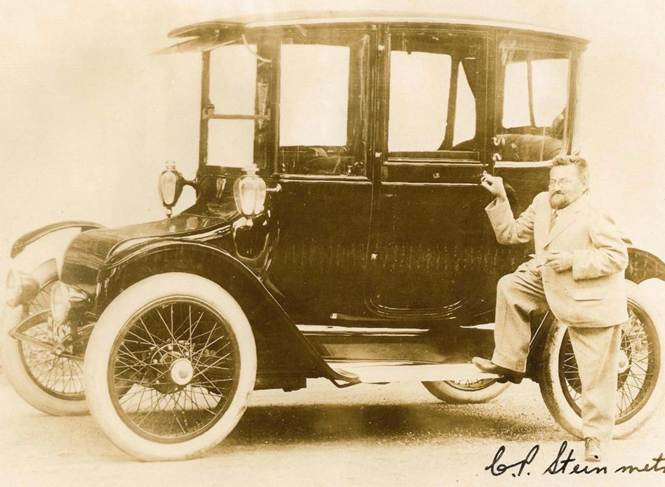
1914 Model 48 Duplex Drive with Charles Proteus
Steinmetz.
The Chicago sales branch proved to be a hub of activity. In 1915 the Anderson Company moved the sales and distribution offices to Chicago. D. E. Whipple, one of the company's most successful sales managers, was placed in charge. The two-story factory branch had a prime “motor row” location at 2416 Michigan Avenue. It was faced in white enameled terra-cotta panels, accented with green bands, presenting a 45-foot frontage between the Cadillac and Pierce-Arrow dealerships. From 1914 to 1920, Rauch & Lang was across the street on the same block. Anderson built an additional facility across the alley and fronting Wabash for expanded garage and repair space. Down the alley, at 61, 24th Street, they had a shop for battery rebuilding and restoring electrics of all makes. Detroit Electric claimed 900 of their cars were in Chicago, more than in Detroit. Around 15 electric car brands had Chicago showrooms, and there were some 70 charging garages.
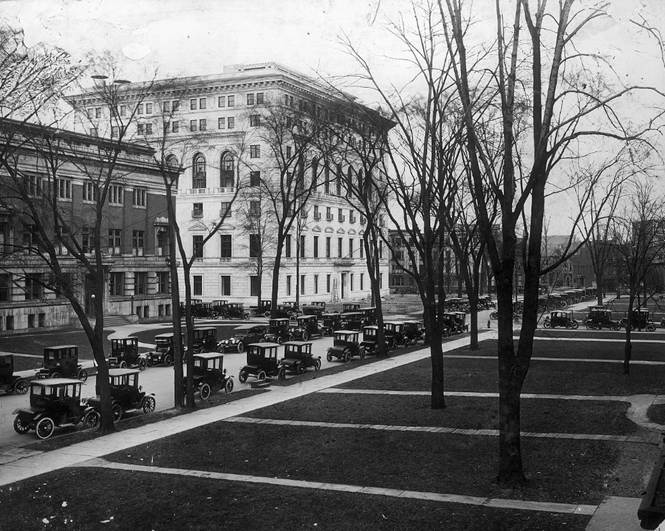
Detroit Athletic Club, “Ladies Preview Day” April 16, 1915
This photo, taken the day before its official opening for male members, shows the new home of the Detroit Athletic Club. It was financed by captains of the auto industry. About fifty of the sixty-five visible cars, driven by their wives, are electric. In bad weather, especially at night, the electric was everyone’s favorite.
In 1916 and 1917, with sales hovering just under two thousand units per annum, Anderson was still in expansion mode, opening a fancy Los Angeles factory showroom. Anderson management seemed oblivious to the paradigm shift to a war economy until the US declared war on Germany in April of 1917.
To deal with the emergence of several newer companies with functionally similar cars at a slightly lower price point, Anderson designed a new model that could be sold for less. These had a simpler controller located under the seat and were known as the Type B “light chassis” cars. Introduced with the model 68 in mid-1916, they came to dominate production.
On June 27, 1918 Anderson opened a large new factory, repurposed for the production of ambulance bodies, which suddenly came to dominate coach-building work. The market for ambulances would collapse only five months later when the First World War ended, leaving the company with a lot of excess factory capacity. At the same time, the luxury electric car market was fading, with only 500 Detroit Electrics shipped in 1919.
As the war ended, the world was traumatized by a second event, the influenza pandemic. It lasted from January 1918 through December 1920. This novel influenza was an even greater trauma to the United States than the war, killing four times as many people. Estimates are that more than 50 million people died from the flu worldwide. There were 500,000 to 675,000 deaths in the US alone. The mortality rate was over a hundred times greater than for typical seasonal influenza. Not only was this flu more deadly than usual, it was most lethal to healthy young people in the prime of life, as their more vigorous immune systems overreacted. It struck the rich as well as the poor, exacerbating the post war recession’s damping of luxury vehicle sales.
The Company had expanded into a diminishing market. At the peak, there were about fifteen hundred employees. After the end of the First World War, making bodies for vehicles with gasoline engines became Anderson’s principal business. In Cleveland, Morris Towson took Elwell-Parker back to independence and pursued its growing business making electric specialty vehicles such as forklifts and tows. The least valuable part of Anderson was the electric pleasure car business. That part was continued by Anderson, Price, and Bacon. Although less valuable, it was not encumbered by debt and was still profitable.
The Milwaukee Junction factory campus became an independent coach-building company, owned by the other Anderson investors, making automobile bodies under contract. Elwell-Parker prospered through the rest of the century. Anderson’s large factory campus, now a coach builder with capacity far in excess of postwar demand, went into receivership within a few years. The new Detroit Electric Car Company went out of business rather slowly. Other than reputation, the principal electric car assets were dozens of rolling chassis and unfinished Brougham bodies. Production of electric cars moved to a leased factory on Mt. Elliott, near the Hupmobile plant. W. C. Anderson and his son-in-law Frank Price, who also became Detroit sales agent for Elwell-Parker. ran the business side. George Bacon was still the lead engineer, E. T. Stretch and several other key employees also followed. The majority of cars sold from late 1919 through October of 1920 were of a contemporary faux radiator sedan type, utilizing old stock chassis, with contemporary bodies from the H & M (Hupp & Mitchell) Body Company in Racine, Wisconsin. Parked on the street, these models could easily be confused with any number of gasoline cars made at the time, such as Overland or Fiat. They did not feel as luxurious. The Broughams, from 1919 on, were built with old stock, from when the factory was going full tilt, just a few years earlier.
Although W. C. Anderson retained the title of president, day-to-day management was left to Frank Price and George Bacon. William C. began spending more time at his summer place on Lake Shore Drive in Mt. Clemons, Michigan.
Anderson and Price were not interested in making George Bacon’s new delivery truck design (with up to four driving positions). Bacon left the company in 1924 and co-founded the Detroit Industrial Vehicle Company (DIVCO); effectively closing the engineering department. Detroit Electric then moved to an even smaller factory at 540 Piquette, where they continued producing the type B light-chassis Brougham through 1929. The last entirely new car of any style was made mid-1926. The cars sold as “new” from then on were remanufactured cars, some with modified older brougham bodies, and others with “borrowed” sedan bodies from other makes. Anderson had been remanufacturing cars since 1915, setting up shops in Detroit and Chicago for this purpose.
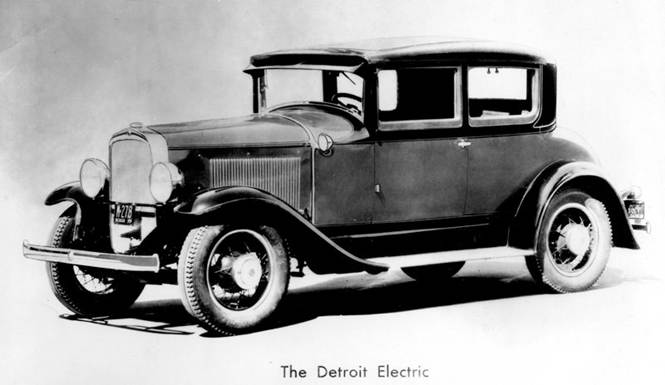
1928-’32 Model 99 “A” on type B chassis
William C. Anderson was seventy-five and in failing health (DOD 11-9-1929) so he put the company up for sale. Car company liquidator, Alfred O. Dunk, purchased Detroit Electric in 1929, several months before the stock market crash.
Some of the money from the sale built a fine new 9,500 sq ft Georgian Mansion at 70 Vendome, Gross Point Farms, Michigan. It was the new residence of Company VP Frank Price and Anderson’s daughter, Mary Price. Built of red brick, it had a cut-stone entryway and window frames, four garages, three gables, two stories, and marble floors.
A. O. Dunk’s main business was buying bankrupt car companies and selling both old stock and replica parts for the orphaned cars. Unlike most customers, Detroit Electric owners didn’t want old parts as much as new cars and continuing service. Faced with these orders Dunk continued operation under the same company name from his factory and warehouse at Lafayette Avenue & Tenth Street.
Dunk’s crew, which included some former Anderson employees, remanufactured earlier cars into model 97s or 98s by adding balloon tires, modern fenders, a dashboard and lowering the roof. They also made “new” Model 99s with Willys bodies on old chassis. The last Dunk car was shipped November 17th, 1932. The great depression forced liquidation of this enterprise, and Dunk’s “right hand man” Alfred F. Renz took over the electric car business, under a new company name, as compensation for unpaid salary. In late 1933 Renz set up shop in a rented corner of the same factory. He managed to make a living through the depression by maintaining electric cars for wealthy widows. Renz also sold 27 used and 15 “new” Detroit Electrics up to 1940. The “new” cars were model 99s, now with a Dodge hood and Fisher based cabin, on 1916-1919 type B chassis.
The Anderson Electric Car Company was not an innovator. The key to their success was a solid product with a marketing approach that fitted the times and customer base. The competition often sold cars through loose networks of dealers. Anderson owned both the dealerships and service garages in major markets. They kept a close watch on authorized dealers, who were chosen from those already successful at selling luxury gasoline cars. It was common for a wealthy client to have a gasoline touring car and an electric coupé in the same garage. The company kept tight control over their dealership network, filing breach of contract suits against those not up to standards.
With single-minded focus, a top-quality product, and stable ownership, Detroit Electric managed to outsell and outlast all of their competition.
Version: 4.9